By: Margaret Paxton - Updated: 1 Sep 2021|*Discuss
The work of an equine veterinary nurse is necessarily more of a specialist job, compared to that of a small animal veterinary nurse. They deal with all aspects of horse care and the related veterinary procedures.
Entry Requirements
The minimum age to start training at an approved equine training practice is 17 years.To be considered for training, candidates need 5 GCSEs at Grade C or above and subjectsmust include English, Maths and 1 Science (Biology, Physics, Chemistry). Comparable qualifications may be considered for example, NVQ/SVQ at Levels 2 and 3. A background of working with horses is recommended and personal fitness essential.
For people who already hold the Veterinary Nurse qualification, and are listed with the Royal College of Veterinary Surgeons, a fast track/add on is possible; provided they have a minimum of 2 years post-qualification experience of working at a suitable equine practice. Consideration should be given for the possible expenses incurred to cover examination entry fees and courses.
What Does an EVN Do?
Equine Veterinary Nurses (EVNs) have to deal with all aspects of horse care. Once qualified, theymay take on more responsibility but remain under the professional supervision of vets. The student nurses complete routine jobs like mucking out and disinfecting stables, sterilising surgical instruments, feeding and leading horses. They are monitored by senior nurses and appropriately assessor-trained vets.
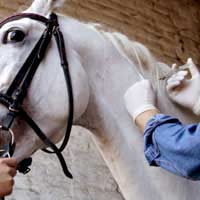
EVNs assist vets in the preparation of drugs, are permitted to give catheter injections, intra-muscular and subcutaneous injections (with veterinary supervision of quantities). Theyalso care for in-patients, prepare and carry out laboratory work and help the vets insurgery/clinics and theatre. Good communication skills are important for giving feedback onpatients and to assist the smooth running of their teams. Teamwork is essential, particularlywhen everyone is working under pressure for example, in the diagnosis and immediate treatment of emergency cases.
Facilities and Duties
Specialist equine clinics have the facilities to deal with a broad range of conditions on site. A main block of stables is commonly used for general care patients so they have company without the risk of injury to each other.
Isolation areas with stables will be required for infectious, suspected infectious or currently undiagnosed patients. Named members of staff, including a vet, an EVN and a student, per shift, will normally be the only people permitted to enter this area. Each of these will work according to strict isolation procedures.
A separate mare and foal facility is provided to keep mares and foals together during treatment of either or both, to minimise disruption of their close bond and avoid added stress. Brood mares may stay in another area for Artificial Insemination treatment.
Stallions are kept away from other horses at all times.
Preparation boxes are kept empty of bedding and water, to facilitate the preparation of horses for surgery and for ease of disinfection. The operating theatre itself has a special floor-to-ceiling, anti-bacterial coating and houses the heavy-duty surgical equipment needed to manoeuvre and operate on these large patients! Nurses will prepare for, and clear up after, surgery.
Following operations the EVNs monitor patients’ in specially padded recovery rooms and keep concise records of each horse. They report their findings to the duty vets and alert them to any significant changes in the patients’ condition.
Summary
Work and conditions for EVNs can be physically demanding. They are required to workon a rota that covers night duty and weekends and be prepared to assist vets in a large variety of tasks. Promotional prospects are quite good and a Head Nurse can sometimes command between £23,000 and £27,000.
Related Articles in the 'Animal Health' Category...
Hi 'm 14 years old and im currently about to go into grade 10 and starting to choose our new classes. i was wondering what subjects i was needing to apply for to become a equine vetrinarian
Phoebe - 1-Sep @ 12:52 AM
Hi i'm currently studying year 12 I was told by my school the only way to become an equine vet is to finish year 12 and get an ATAR but I was was just wondering if there is another way to get into equine care another way.
leash - 10-Feb @ 9:42 PM
i am 12 and when i am older i want to be an equine vetinary nuse because i love horses and i like to make sure they are safe.i have my own horses and i always train on them even when they are not injured.
thanks abby eason
abbyeason223 - 11-Sep @ 2:28 PM
Hello I’m looking for advice I’m currently studying level 4 animal biology and science at college and been accepted for NC animal care however I’m stuck I really want a career in equine veterinary I don’t know who to turn to foradvice what can I do to get someone to give me a chance and take me on in a working environment as a student any advice or any course related advice would be greatly appreciated
Bonnie - 11-Jun @ 9:22 PM
at the moment i am 12 years old and when im older i want to own a farm with a cafe and a vets on the farm but i also like to rescue the animals in the garden and dogs and cats on the street that i find abandoned that are potentially injured but at the moment i have no clue how to treat them and i think it would be helpfull for advice for me, if somebody could comment some websites to help me. i am very good with animals andhave 6 snakes 2 guinea pigs 1 hamster 1 dog 1 cat 3 horse's and a parrot. i would apreachiate all of your help.
ganimals - 30-May @ 9:42 PM
@Becki - you could see if this is something you could do via an apprenticeship. I have also included a link via the British Horse Society here which gives you more information regarding the best training path to take. I hope this helps and good luck.
CareerWithAnimals - 26-Mar @ 11:27 AM
I have 12 GCSEs maths,English and chemistry my grades were B,s,Biology &physics were C's, I have a background with working with horses and have good physical fitness, where do I go to find the vacancies of Equine vetinary nurse as I fel this is what I would really be interested to have as a career with a possibility of continuing training.
Becki - 23-Mar @ 1:50 PM
Hi I worked with horses for eleven years and always had an interest when the vet was there. Does any one know how to get involved in training to be an equine vet nurse and is there much call for the job once you have trained for it. Thanks
Julie
Jules - 17-Nov @ 9:58 PM
Hello, I want to study to become an equine vet nurse. Id rather take the direct route by doing the NVQs needed and then going to an EVN course. I cant seem to find a course that does this in the north east of england, if you wouldn't mind helping me. Thanks Beth Gallagher
bethgallagher - 20-Jan @ 2:45 PM
As Senior Instructor at an RDA Centre I am becoming further removed from the actual horses. I would like it to be all about them again, and helping to fix the things that we put wrong.
Hayley Re: Run your own Animal Shelter
I am looking to open my own combined veterinary practice and animal rescue to support animals in need, provide education to the…
18 November 2025
Tazzi Re: Run your own Animal Shelter
Hello guys, just came across this site and it warms my heart that there aren't many people willing to help these little guys.…
GinA Re: Run your own Animal Shelter
Hello I am live in birmingham and I really like to open rescue centre for animals . Please help me with the step by step
29 March 2025
Fitzy Re: Run your own Animal Shelter
Just read this. I was considering buying land with stables into a cat sanctuary and I didn't realise you have to approach a council…
1 March 2025
Han Re: Run your own Animal Shelter
Hi all, I currently manage a children's home and love it but I have always wanted to care for animals. Can anyone help me to learn…
18 January 2025
Tsveti Re: Work with Farm Animals or on a Farm
Hi I'm from Bulgaria.I was looking a job for farms with animals.I have 1.5 years experience at pigs farm and 3 years for…
17 January 2025
Jon Re: Work as a Flying Groom
Hi there this is a useful article, however how do you actually go about finding employment in this role? Please advise.
Best wishes
Jon
15 January 2025
Rob Re: General Work Experience with Animals
I am currently in year 10 and I was looking into your placements as I will need one week of experience in July. I am…
12 January 2025
Emma Re: Run your own Animal Shelter
Hi I see there are like minded individuals who feel and know the need to help animals more so now than ever! It would be amazing if…


Re: Run your own Animal Shelter
I am looking to open my own combined veterinary practice and animal rescue to support animals in need, provide education to the…
Re: Run your own Animal Shelter
Hello guys, just came across this site and it warms my heart that there aren't many people willing to help these little guys.…
Re: Work With Horses: Becoming a Stablehand
Hey my names Ava and I just turned 14 a few days ago, I have lots of experience with both riding and handling horses…
Re: Run your own Animal Shelter
Hello I am live in birmingham and I really like to open rescue centre for animals . Please help me with the step by step
Re: Run your own Animal Shelter
Just read this. I was considering buying land with stables into a cat sanctuary and I didn't realise you have to approach a council…
Re: Run your own Animal Shelter
Hi all, I currently manage a children's home and love it but I have always wanted to care for animals. Can anyone help me to learn…
Re: Work with Farm Animals or on a Farm
Hi I'm from Bulgaria.I was looking a job for farms with animals.I have 1.5 years experience at pigs farm and 3 years for…
Re: Work as a Flying Groom
Hi there this is a useful article, however how do you actually go about finding employment in this role? Please advise. Best wishes Jon
Re: General Work Experience with Animals
I am currently in year 10 and I was looking into your placements as I will need one week of experience in July. I am…
Re: Run your own Animal Shelter
Hi I see there are like minded individuals who feel and know the need to help animals more so now than ever! It would be amazing if…